Navega sin publicidad Regístrate GRATIS
 
  Si ya estás registrado/a Identifícate

Estudio Global de Funciones

💬 1

  Ejercicios_Resueltosestudio global de funciónfunciones

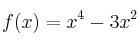
Realiza un estudio global (dominio, simetrías, corte con los ejes, asíntotas, monotonía, extremos y representación gráfica) de la función:
f(x) = x^4-3x^2

SOLUCIÓN

Estudio global de f(x) = x^4-3x^2

Dominio

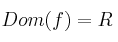
Dom(f) = R
El dominio de cualquier función polinómica es "todos los números reales"

Asíntotas

Una función polinómica no tiene asíntotas.

Simetrías

f(-x) = (-x)^4-3(-x)^2 = x^4-3x^2 = f(x)
Es una función par (simétrica respecto al eje OY)

Corte con los ejes

 Si x = 0 entonces y = 0. Punto:(0,0)
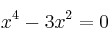
 Si y=0 entonces x^4-3x^2=0. Resolvemos la ecuación:
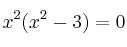
x^2(x^2-3)=0 de donde:
\rightarrow x=0
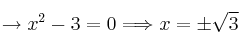
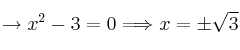
\rightarrow x^2-3=0 \Longrightarrow x=\pm \sqrt3
Puntos: (0,0) , (\sqrt3,0) , (-\sqrt3,0)

Monotonía

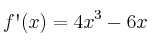
f\textsc{\char13}(x)=4x^3-6x
f\textsc{\char13}(x)=0 \Longrightarrow 4x^3-6x=0 \Longrightarrow x(4x^2-6)=0
De donde:
\rightarrow x=0
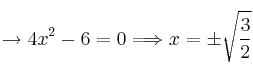
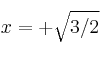
\rightarrow 4x^2-6=0 \Longrightarrow x=\pm \sqrt\frac32
Intervalos:
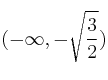
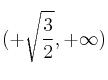
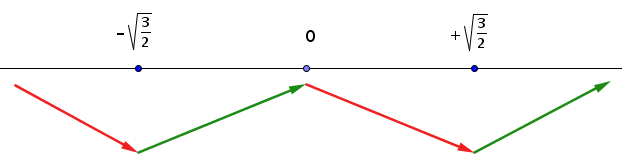
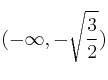
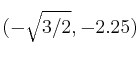
(-\infty, -\sqrt\frac32) , (-\sqrt\frac32 , 0) , (0, +\sqrt\frac32) , (+\sqrt\frac32 , +\infty)

Tomamos un punto de cada intervalo para ver el signo de la derivada (positivo significa creciente y negativo decreciente)

 f\textsc{\char13}(-2) = 4(-2)^3-6(-2)=-32+12=-20 < 0\Longrightarrow DECRECIENTE
 f\textsc{\char13}(-1) = 4(-1)^3-6(-1)=-4+6=2 > 0\Longrightarrow CRECIENTE
 f\textsc{\char13}(1) = 4(1)^3-6(1)=4-6=-2 < 0\Longrightarrow DECRECIENTE
 f\textsc{\char13}(2) = 4(2)^3-6(2)=32-12=20 > 0\Longrightarrow CRECIENTE

Extremos

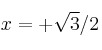
Aplicamos la derivada segunda a los puntos 0 \: ,\: \pm \sqrt3/2

f\textsc{\char13}\textsc{\char13}(x) = 12x^2-6

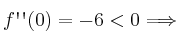
 f\textsc{\char13}\textsc{\char13}(0) = -6 < 0 \Longrightarrow MÁXIMO en x=0
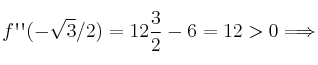
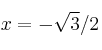
 f\textsc{\char13}\textsc{\char13}(-\sqrt3/2) = 12\frac32-6=12 > 0 \Longrightarrow MÍNIMO en x=-\sqrt3/2
 f\textsc{\char13}\textsc{\char13}(-\sqrt3/2) = 12\frac32-6=12 > 0 \Longrightarrow MÍNIMO en x=+\sqrt3/2
Calculemos la imagen de los extremos para conocer la segunda coordenada:
 f(0) = 0^4-3 \cdot 0^2 = 0 \Longrightarrow MAX(0,0)
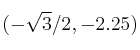
 f\left(-\sqrt3/2 \right) = \left( -\sqrt3/2\right)^4-3 \cdot \left( -\sqrt3/2 \right)^2 = -2.25 \Longrightarrow MIN(-\sqrt3/2, -2.25)
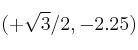
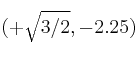
 f\left(+\sqrt3/2 \right) = \left( +\sqrt3/2\right)^4-3 \cdot \left( +\sqrt3/2 \right)^2 = -2.25 \Longrightarrow MIN(+\sqrt3/2, -2.25)

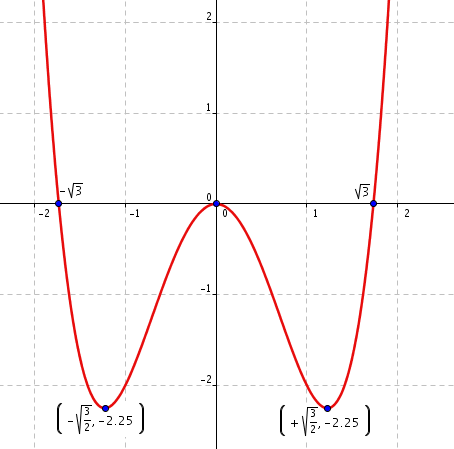
Gráfica

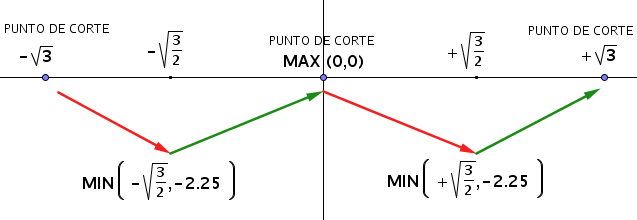
Con los datos obtenidos anteriormente:


podemos ya dibujar la gráfica:

Comentar el ejercicio

Mensajes

  • Estudio global de f(x) = x^4-3x^2

    Dominio

    Dom(f) = R
    El dominio de cualquier función polinómica es "todos los números reales"

    Asíntotas

    Una función polinómica no tiene asíntotas.

    Simetrías

    f(-x) = (-x)^4-3(-x)^2 = x^4-3x^2 = f(x)
    Es una función par (simétrica respecto al eje OY)

    Corte con los ejes

     Si x = 0 entonces y = 0. Punto:(0,0)
     Si y=0 entonces x^4-3x^2=0. Resolvemos la ecuación:
    x^2(x^2-3)=0 de donde:
    \rightarrow x=0
    \rightarrow  x^2-3=0 \Longrightarrow x=\pm \sqrt{3}
    Puntos: (0,0) , (\sqrt{3},0) , (-\sqrt{3},0)

    Monotonía

    f’(x)=4x^3-6x
    f’(x)=0 \Longrightarrow 4x^3-6x=0 \Longrightarrow x(4x^2-6)=0
    De donde:
    \rightarrow x=0
    \rightarrow 4x^2-6=0 \Longrightarrow x=\pm \sqrt{\frac{3}{2}}

    Intervalos:
    (-\infty, -\sqrt{\frac{3}{2}}) , (-\sqrt{\frac{3}{2}} , 0) , (0, +\sqrt{\frac{3}{2}}) , (+\sqrt{\frac{3}{2}} , +\infty)

    Tomamos un punto de cada intervalo para ver el signo de la derivada (positivo significa creciente y negativo decreciente)

     f’(-2) = 4(-2)^3-6(-2)=-32+12=-20 < 0\Longrightarrow DECRECIENTE
     f’(-1) = 4(-1)^3-6(-1)=-4+6=2 > 0\Longrightarrow CRECIENTE
     f’(1) = 4(1)^3-6(1)=4-6=-2 < 0\Longrightarrow DECRECIENTE
     f’(2) = 4(2)^3-6(2)=32-12=20 > 0\Longrightarrow CRECIENTE

    ej_2257a.png

    Extremos

    Aplicamos la derivada segunda a los puntos 0 , \pm \sqrt{3/2}
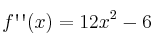
    f’’(x) = 12x^2-6

     f’’(0) = -6 < 0 \Longrightarrow MÁXIMO en x=0
     f’’(-\sqrt{3/2}) = 12\frac{3}{2}-6=12 > 0 \Longrightarrow MÍNIMO en x=-\sqrt{3/2}
     f’’(-\sqrt{3/2}) = 12\frac{3}{2}-6=12 > 0 \Longrightarrow MÍNIMO en x=+\sqrt{3/2}

    Calculemos la imagen de los extremos para conocer la segunda coordenada:

     f(0) = 0^4-3 \cdot 0^2 = 0 \Longrightarrow MAX(0,0)
     f\left(-\sqrt{3/2} \right) = \left( -\sqrt{3/2}\right)^4-3 \cdot \left( -\sqrt{3/2} \right)^2 = -2.25 \LongrightarrowMIN(-\sqrt{3/2}, -2.25)
     f\left(+\sqrt{3/2} \right) = \left( +\sqrt{3/2}\right)^4-3 \cdot \left( +\sqrt{3/2} \right)^2 = -2.25 \Longrightarrow MIN(+\sqrt{3/2}, -2.25)

    Gráfica

    Con los datos obtenidos anteriormente:
    ej_2257b.png


    podemos ya dibujar la gráfica:

    ej_2257c.png